


BRIGHT Grant
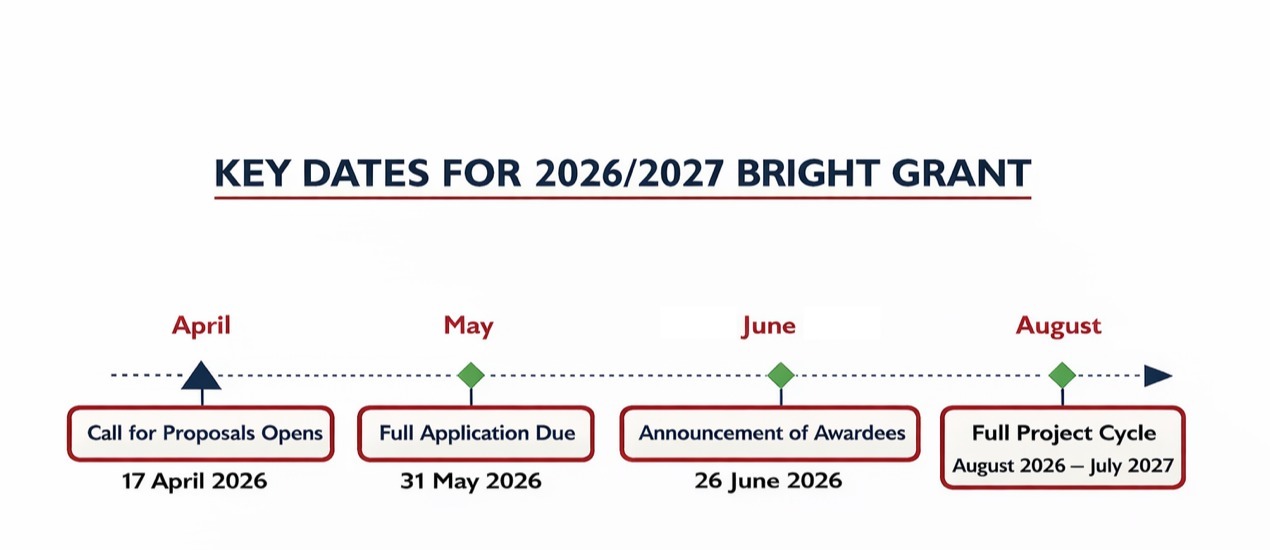
BRIGHT Grant is now accepting applications from all BRIGHT Network members. The completed full application package is due on 31 May 2026, with awardees to be announced on 26 June 2026. Applicants are strongly encouraged to start preparing early; for details on eligibility criteria, application materials, and key dates, please visit the BRIGHT Grant webpage.
Program overview:
The BRIGHT Grant is a competitive awards program funded by Research Fund, Vanke School of Public Health (VSPH), Tsinghua University. This program invites BRIGHT Network members to apply for funds to support research and capacity-building activities on topics of importance to solving critical global health challenges. The funded projects are conducted in partnership with Tsinghua mentor researchers. The BRIGHT Grant helps to nurture the professional development of early career researchers from developing countries, and ultimately provides the grant recipients with the knowledge, skills, and connections to further their careers as leaders in global health research.
Research focus and Priority area:
The BRIGHT Grant funding opportunity looks to support locally-led research projects that 1) generate context-specific evidence on how public health challenges affect populations in LMICs; and 2) explore or assess approaches that may help individuals, communities, and health systems respond to these challenges. Proposals are expected to demonstrate clear research questions, appropriate study design, and relevance to policy or practice.
In the 2026/27 application cycle, the BRIGHT Grant will support proposals addressing the following five priority areas. Each area includes indicative directions to guide proposal development, while allowing flexibility for context-specific research design.
1. Toward Context-Specific Solutions in Maternal and Infant Nutrition
Maternal and infant malnutrition remains one of the most pressing public health challenges in low- and middle-income countries, with consequences extending across the life course and affecting long-term societal development. While a range of evidence-based interventions have been developed worldwide—including multiple micronutrient supplements (e.g. Yingyangbao in China), dietary guidelines, and complementary feeding strategies—their effectiveness is often shaped by local cultural practices, dietary habits, and socio-ecological contexts, requiring systematic local adaptation. Moreover, growing external uncertainties, including climate change and geopolitical instability, have heightened the urgency for context-specific innovations in nutrition promotion strategies. With a particular focus on locally sourced, nutrient-fortified complementary foods and the optimization of micronutrient supplement compositions in response to endemic infectious diseases, this area seeks to support research that:
• identifies and analyses context-specific nutritional challenges and their determinants
• explores innovative nutrition strategies utilizing local resources
• examines the implementation and adaptation of nutrition interventions in local settings
2. Building Climate-Resilient Maternal and Child Health Systems
Climate change has become a major public health challenge of the 21st century. Maternal and child populations are among the earliest and most vulnerable groups affected by climate-related health risks, highlighting the urgent need to develop climate-resilient maternal and child health systems.
This area seeks to support research that advances understanding of how climate change impacts maternal and child health and related health systems, identifies current system responses and their limitations, and examines the barriers and needs in building climate-adaptive health systems. The aim is to generate evidence to inform policymakers, health system managers, and other stakeholders, and to support actionable responses to protect vulnerable populations.
Recent field-based research, including studies conducted in China, has identified system vulnerabilities, key barriers, and context-specific needs in responding to climate-related health risks. Building on this emerging evidence base, this area encourages research that incorporates comparative or cross-country perspectives. Proposals may explore:
• whether maternal and child health systems facing similar climate risks exhibit comparable patterns of vulnerability
• how adaptation strategies differ across contexts and health system settings
• what lessons can be drawn from international experiences to inform context-specific system strengthening
3. Mobile Phone Use and Domestic Violence: Evidence and Mechanisms
With the rapid expansion of mobile communication technologies, mobile phones have become deeply embedded in everyday life and may play an important yet underexplored role in shaping domestic violence dynamics. According to the Technology Affordance Theory, beyond their function as communication tools, mobile phones may introduce context-specific affordances—such as communication, visibility, and reporting—that influence behaviour when perceived and utilized. In the context of domestic violence, access to mobile phones may affect help-seeking, reporting, and the visibility of abusive behaviours, thereby shaping the responses of victims, perpetrators, and bystanders. Through these mechanisms, mobile phone use has the potential to reshape the social environment in which violence occurs and reduce the likelihood of abuse. This area seeks to support research that:
• explores how digital access interacts with social norms and institutional contexts, and examines the relationship between mobile phone use and domestic violence
• investigates underlying mechanisms, including communication, reporting, and visibility, to inform evidence-based policy interventions in the digital era.
4. Strengthening Community Health Worker Capacity for Elderly Care in LMICs
Low- and middle-income countries are experiencing rapid population aging, yet their primary health care systems often lack adequate capacity to respond to the growing needs of older adults. Many of these settings have established community health worker (CHW) networks, which may represent an important but underutilized resource for improving elderly care access. There is a need to better understand the current capacity of CHWs in elderly care and to identify feasible approaches to strengthening their role within primary health care systems. This area supports research that:
• assesses CHW knowledge, skills, and practices related to elderly care; identifies capacity gaps and system-level constraints
• develops or evaluates context-appropriate capacity-building approaches to produce scalable tools and policy recommendations.
5. Improving Access to Innovative Point-of-Care Diagnostics for Tuberculosis in Primary Health Care
In many low- and middle-income countries, most patients receive care in primary health care settings, yet access to molecular diagnostics for priority conditions such as tuberculosis is severely limited. This contributes to delays in diagnosis, loss to follow-up, and increased costs for both patients and health systems. Expanding access to affordable and accessible point-of-care diagnostic tools has the potential to improve early detection and strengthen primary health care services. With a focus on Tuberculosis, this area seeks to support research that:
• examines barriers to access and use of diagnostic tools in primary health care settings
• explores implementation challenges and enabling factors for point-of-care diagnostics
• identifies strategies to improve affordability, accessibility, and system integration
Eligibility
The BRIGHT Grant invites applications from BRIGHT Network members who are eligible to serve as Principal Investigators (PIs) on the proposed study. All funded projects will be conducted in collaboration with mentor scientists from VSPH. The mentor is expected to provide academic guidance and support throughout the research process.
Funding and Duration
Up to five projects will be funded in the 2026/27 application cycle. Each project is expected to run for a period of 12 months.
Each award will be for a maximum of USD 28,000. Funds will be made available to the applicant’s institution at the start of the project term, following the signing of a project contract between Tsinghua University and the recipient institution.

Copyright © 2022 All rights reserved
Bringing Research to Impact for Global Health at Tsinghua
CONTACT US
caldi@tsinghua.edu.cn


 Join Us
 Log In
 Log Out